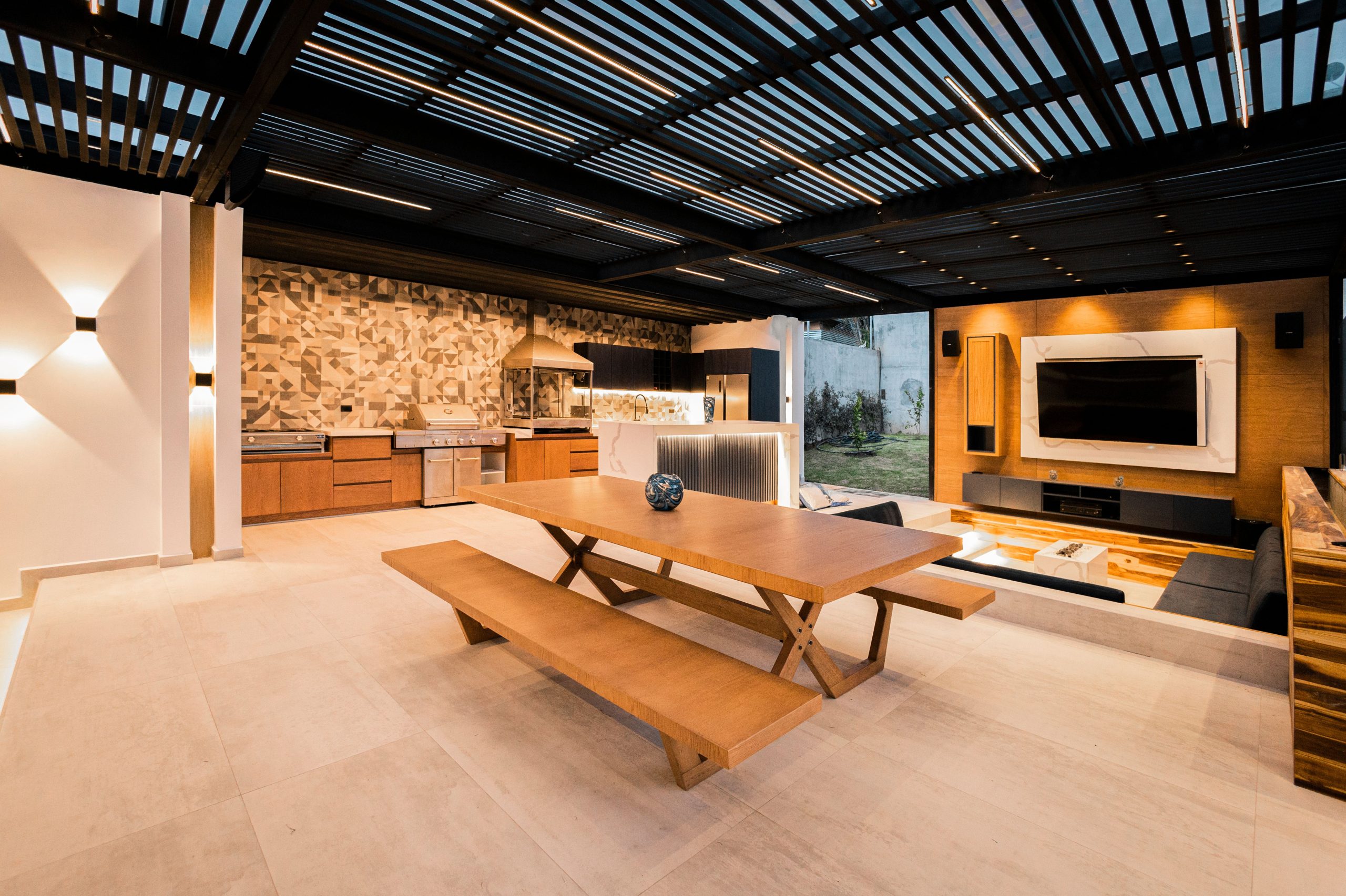
The modern backyard is no longer treated as the place where outdoor furniture waits for summer. It is increasingly planned as an entertainment environment: somewhere to cook while talking to guests, watch a film without moving indoors, host a long dinner, or divide a single gathering into several smaller conversations.
That shift changes the design brief. A successful outdoor entertainment space is not necessarily the largest or most expensive one. It is the one that makes the next action obvious: food is within reach, people can see one another, lighting changes with the evening, and the surface underfoot can cope with real use. Even material choices such as composite decking are now being considered as part of that wider entertainment plan rather than as an isolated flooring decision.
Why the backyard is taking on an entertainment role
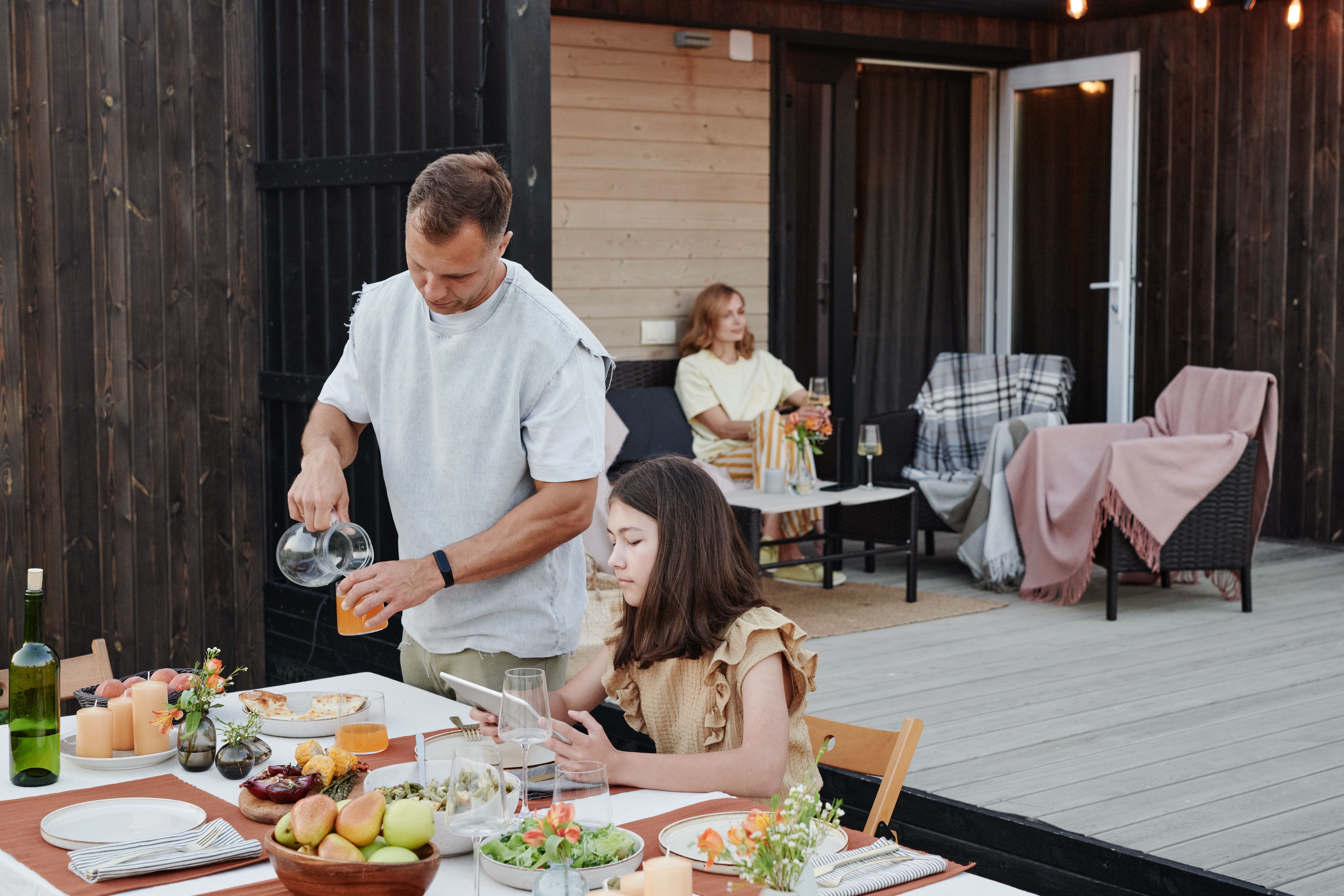
Outdoor entertainment has moved beyond the occasional barbecue because the space now supports more than one kind of gathering. A family may eat outside, move to a fire feature after dinner, and finish the evening with music or a film. The furniture, lighting, power, and circulation have to support that sequence.
Research from Houzz helps explain the change, while also showing why broad claims about “homeowners” should be handled carefully. Its 2024 U.S. Outdoor Trends Study surveyed 1,106 registered Houzz users who had recently completed, were working on, or planned an outdoor or exterior project. Among those respondents:
- 33% said they were extending their living spaces.
- Entertainment was a motivation for 44% of Millennials and 42% of Gen X respondents, compared with 34% of Baby Boomers.
- 12% added or upgraded an outdoor kitchen.
- 78% of respondents undertaking outdoor system projects upgraded outdoor lighting.
Those figures do not prove that every household wants a luxury backyard. They do show that outdoor renovation is being judged by how well it supports daily life and social activity, not only by how attractive it looks from inside the house.
The important shift: designing zones, not one big patio
The old approach was often a single paved rectangle with a table in the middle. That can work, but it asks one area to handle every activity at once. Modern outdoor entertainment spaces are more flexible when they are divided into zones with clear relationships.
| Zone | Primary activity | Design priority |
|---|---|---|
| Dining zone | Meals and extended conversation | Comfortable seating, task lighting, and a clear route to food |
| Cooking zone | Preparation and serving | Heat-safe surfaces, storage, ventilation, and worktop space |
| Lounge zone | Relaxed conversation, reading, or viewing | Soft seating, lower lighting, and protection from glare |
| Activity zone | Games, children’s play, or informal standing groups | Open circulation and surfaces that tolerate spills and movement |
The zones should not feel like four separate rooms. Their value comes from overlap. A person cooking should still be part of the conversation; someone sitting near the screen should not block the route to the table; and a child’s play area should be visible without becoming the centre of every adult gathering.
The best outdoor layouts choreograph movement. Guests should be able to arrive, find a drink, join a conversation, and reach the bathroom or kitchen without crossing through the busiest work area.
What the available homeowner data shows
The Houzz study is useful because it separates different kinds of outdoor work instead of treating every upgrade as a single trend. The figures below come from its 2024 U.S. Outdoor Trends Study and refer to respondents who reported particular outdoor projects or motivations. They are not a forecast for the entire housing market.
| Finding | Share reported | Why it matters for entertainment |
|---|---|---|
| Outdoor areas extended living spaces | 33% on average | The space is being planned for regular use, not only occasional events |
| Entertainment was a motivation among Millennials | 44% | Flexible hosting is part of the brief for many younger renovating homeowners |
| Entertainment was a motivation among Gen X respondents | 42% | The pattern is not limited to one age group |
| Outdoor kitchens were added or upgraded | 12% | Food preparation is increasingly placed inside the social area |
| Outdoor system projects included lighting upgrades | 78% | Evening usability depends on more than decorative furniture |
Source: 2024 U.S. Houzz Outdoor Trends Study, fielded May 25 to June 5, 2024.
An outdoor kitchen is often described as a convenience, but its more important function is social. It keeps the person preparing food in the same general area as everyone else. That matters because cooking is frequently part of the event, not an interruption between activities.
Houzz reported that outdoor kitchen projects commonly involved more than a grill. Among the kitchens in its study, reported components included plumbing, electrical or heating systems, appliances, countertops, storage, and roofing. Grills were the most common appliance or fixture, followed by cooktops, pizza ovens, and smokers or deep fryers.
That does not mean every space needs a built-in kitchen. A compact serving counter, a weatherproof cabinet, and a safe place for a portable grill may create better value in a small yard. The test is simple: does the setup reduce trips indoors without creating a second kitchen that is rarely used?
- Place preparation surfaces beside, not behind, the main seating area.
- Keep hot equipment away from routes used by children and guests.
- Plan for rubbish, recycling, plates, and serving tools from the beginning.
- Use storage to reduce the number of objects that must be carried outside before every gathering.
Screens, sound, and lighting without turning the yard into a showroom
Technology can extend the range of activities outdoors, but it works best when it is quiet in the visual sense. A screen should be viewable from the seats that people actually use. Speakers should support conversation rather than force everyone to compete with a soundtrack. Power points should be accessible without becoming trip hazards.
Lighting has an even larger role because it changes the mood and the function of the space. Use separate layers for:
- Movement: steps, paths, gates, and changes in level.
- Task work: food preparation, serving, and grilling.
- Atmosphere: walls, planting, furniture, and architectural details.
- Viewing: low-glare light around seats so faces remain visible without washing out a screen.
The U.S. Department of Energy’s guidance on purchasing energy-efficient exterior lighting notes that controls can reduce energy use beyond fixture efficiency alone. Timers, dimming, and occupancy controls are particularly useful outdoors because lights are otherwise easy to leave on long after guests have gone.

My preference is to make the lighting scene adaptable rather than bright by default. A dinner setting, a late-night conversation setting, and a path-only setting are more useful than one powerful arrangement that makes the garden feel like a car park.
Weather resilience is part of the entertainment design
A space only becomes part of the home’s entertainment life if people can rely on it. Shade, wind protection, drainage, and heat management are therefore not finishing touches. They determine whether the patio is comfortable enough to use when the weather is merely imperfect.
Consider the following before choosing furniture or technology:
- Where will shade fall at the time guests usually arrive?
- Can a roof, pergola, screen, or planting reduce wind without trapping smoke?
- Where will rainwater go after a heavy shower?
- Can cushions, screens, and small appliances be stored quickly?
- Will surfaces become uncomfortable in direct sun or slippery when wet?
Surface design also has an environmental dimension. The U.S. Environmental Protection Agency explains that permeable pavement can allow rain and snowmelt to infiltrate through the surface into underlying soil and gravel, helping reduce runoff. Its suitability depends on local soil, drainage, maintenance, and installation details, but it is a useful option to discuss when planning walkways, patios, or secondary gathering areas.
A practical planning sequence
People often begin with a wish list: pizza oven, television, fire pit, bar, heaters, speakers. A better process begins with the event itself.
- Describe the typical gathering. Is it a quiet meal for four, a weekly family evening, or a larger party?
- Map the movement. Mark the house door, kitchen route, bathroom route, storage, and the places people naturally stop.
- Choose the primary activity. Let dining, cooking, conversation, or viewing lead the layout instead of giving every feature equal priority.
- Add infrastructure early. Plan power, water, drainage, lighting circuits, and ventilation before surfaces and furniture conceal access.
- Design for the quiet version. If the space is pleasant for one person reading or two people talking, it will be more useful than a yard designed only for parties.
- Test the sightlines. Sit in the intended seats and check the view of the cooking area, screen, garden, and house entrance.
There is also a strong case for building in phases. Start with the surface, shade, lighting, and seating. Add a kitchen or entertainment technology only after the everyday pattern of use is clear. This avoids spending heavily on features that look impressive in a plan but compete with one another in real life.
Frequently Asked Questions
1. What makes an outdoor space suitable for modern entertainment?
A suitable space supports several activities without forcing them into one crowded area. It usually combines comfortable seating, practical lighting, a clear route for food and guests, weather protection, and enough power or storage for the features the household will genuinely use.
2. Does an outdoor entertainment space need a built-in kitchen?
No. A portable grill with a stable work surface, nearby storage, and a serving area can be more practical than a large built-in kitchen. The right choice depends on how often the space is used, what is cooked, and whether the infrastructure can be maintained properly.
3. How should outdoor lighting be planned?
Plan separate lighting for movement, food preparation, atmosphere, and viewing. Use dimming or timers where possible, keep glare away from seating and screens, and make sure steps and changes in level are clearly visible.
4. Is an outdoor television always a good idea?
Not always. A screen is worthwhile when people regularly watch something outdoors and the viewing angle, shade, weather protection, sound, and power have been solved. If those conditions are missing, a flexible lounge or dining area may provide more value.
5. What should be prioritised in a smaller backyard?
Prioritise circulation, comfortable seating, shade, and lighting before adding specialised equipment. A compact space with good movement and a clear social focus usually performs better than one filled with oversized appliances and furniture.
A backyard should earn its place in the evening
The most convincing outdoor entertainment spaces are not replicas of indoor living rooms. They take advantage of what being outside does differently: food can be prepared in view of guests, conversations can spread across several levels of activity, and lighting can make the same setting feel calm or celebratory.
That is why the trend is more durable than a passing preference for outdoor kitchens or patio furniture. The real change is that the backyard is being judged by its ability to host a sequence of experiences. If the layout makes those experiences easy, the space becomes part of the home’s social life. If it only collects equipment, it remains a display area waiting for an occasion.